News
Product updates, announcements, and notes from the Lineman team.
How to Reduce AI Coding Spend With Log Compression in 7 Steps (2026)
Build logs and file reads account for over half of most AI coding bills. The tokens aren't reasoning about your code—they're re-reading the same data, turn after turn. AI infrastructure cost optimization starts by cutting the bytes your model never needed to see in the first place.
Read more →How to Summarize Large Codebases for AI Agents in 7 Steps (2026)
Quick Guide: How to Summarize Large Codebases for AI Agents in 7 Easy Steps Parse Code with Abstract Syntax Trees: Extract meaningful structure from source files using AST parsers that preserve semantic boundaries. Chunk Code at Symbol Boundaries: Split files at function, class, and module boundaries instead of arbitrary line counts. Generate Semantic Embeddings: Convert code chunks into vector representations that capture meaning, not just syntax. Build a Vector Index for Retrieval: Store embeddings in a vector database for fast similarity search across your codebase. Implement Selective Context Retrieval: Query only the relevant code chunks based on the agent's current task. Compress Tool Output Before Context Injection: Use Lineman to automatically compress file reads and logs before they reach your AI agent's context window. Cache and Deduplicate Repeated Reads: Track what the agent has already seen to avoid re-injecting identical content. How to Help AI Agents Understand Large Repositories Without Full-Context Dumps 1. Parse Code with Abstract Syntax Trees The first step is treating code as structure, not text. AST parsers read your source files and produce a tree that represents the actual program logic: functions, classes, imports, and their relationships.
9 Claude Instruction Audits for Leaner DevOps
System instructions in Claude coding agents carry a hidden cost. Every token in your CLAUDE.md file is re-sent on every single turn, whether you need it or not. For DevOps teams running automated pipelines, test triaging, and infrastructure tasks, that overhead compounds across hundreds of daily sessions.
All news
10 LLM Cost Controls for AI Testing Teams
Quick guide: 10 LLM cost controls for enterprise AI testing teams LLM spending in enterprise testing workflows is climbing fast. According to a 2025 Menlo Ventures report , enterprise generative AI spending tripled to $37 billion. Lineman gives your engineering team a clear path to cut token costs by 40%+ in automated testing and bug-fixing workflows without sacrificing output quality.
How to Build an LLM Spend Audit by Department in 7 Steps (2026)
Quick Guide: How to Build an LLM Spend Audit by Department in 7 Steps Define your cost attribution dimensions — Decide whether you'll track by department, team, repository, or individual developer. Set up token telemetry collection — Install an SDK wrapper or proxy that captures every LLM API call with metadata. Configure department tagging — Map each request to a department using git context, API keys, or manual labels. Aggregate costs by time window — Build hourly, daily, and monthly rollups so you can spot trends and spikes. Add prompt compression middleware — Use Lineman to cut token costs by 40%+ while maintaining output quality. Create budget thresholds and alerts — Set per-department limits that notify you before overspending. Export to your FinOps dashboard — Push data to CloudWatch, Prometheus, or your existing observability stack. How to Build a Department-Level LLM Spend Audit 1. Define Your Cost Attribution Dimensions Start by mapping how your organization actually uses LLM APIs. Most engineering teams find that repository-level attribution gives the clearest picture of spend.
How Source Code Context Reduction Cuts LLM Spend
If you manage AI coding tools at scale, you've noticed the bill grows faster than usage does. The root cause: LLM API cost optimization starts with understanding where your tokens actually go. Most of the cost comes from context compounding and verbose tool output, not reasoning.
How to Cut Code Boilerplate Tokens in AI Coding in 7 Steps (2026)
Your AI coding assistant burns tokens on repetitive code boilerplate, file reads, and build logs before it even starts reasoning about your task. Lineman cuts that overhead by 40%+ while maintaining output quality. This guide walks you through seven steps to identify and reduce the redundant context that inflates your token bill.

How to Use Semantic Code Search for AI Codebases
Large codebases present a unique challenge for AI coding assistants: they need relevant context to generate accurate code, but the sheer volume of files makes finding that context difficult. Semantic code search solves this problem by understanding what code does, not just what it says, helping AI agents find the right files without flooding the model's context window.

How to Cut Claude Code Spend Without Quality Loss
Your Claude Code API cost optimization bill keeps climbing, but the output quality needs to stay exactly where it is. This guide walks you through the mechanics that drive Claude Code spend and the four levers that bring it down without touching output quality: model routing, context hygiene, prompt discipline, and automatic tool-output compression.

How to Reduce Claude Code API Costs in 2026
Key Takeaways: How to Reduce Claude Code API Costs in 2026 Claude Code costs are driven by two mechanics: context compounding (every token re-billed per turn) and verbose tool output (file reads, logs, search results). The four levers that cut costs: model routing, context hygiene, prompt discipline, and automatic tool-output compression. Lineman's benchmarks show automatic tool-output compression cuts 40%+ of tokens while maintaining output quality for engineering teams. Run /context to diagnose where your tokens go before applying fixes, and /clear between unrelated tasks to stop paying for stale history. Match the model to the task: Sonnet handles 80% of coding work at roughly one-fifth the cost of Opus per token. Why Claude Code API Costs Climb Faster Than You Expect Your Claude Code bill climbs because of two mechanics working against you on every turn. Once you diagnose both, you can apply the right fix to each.
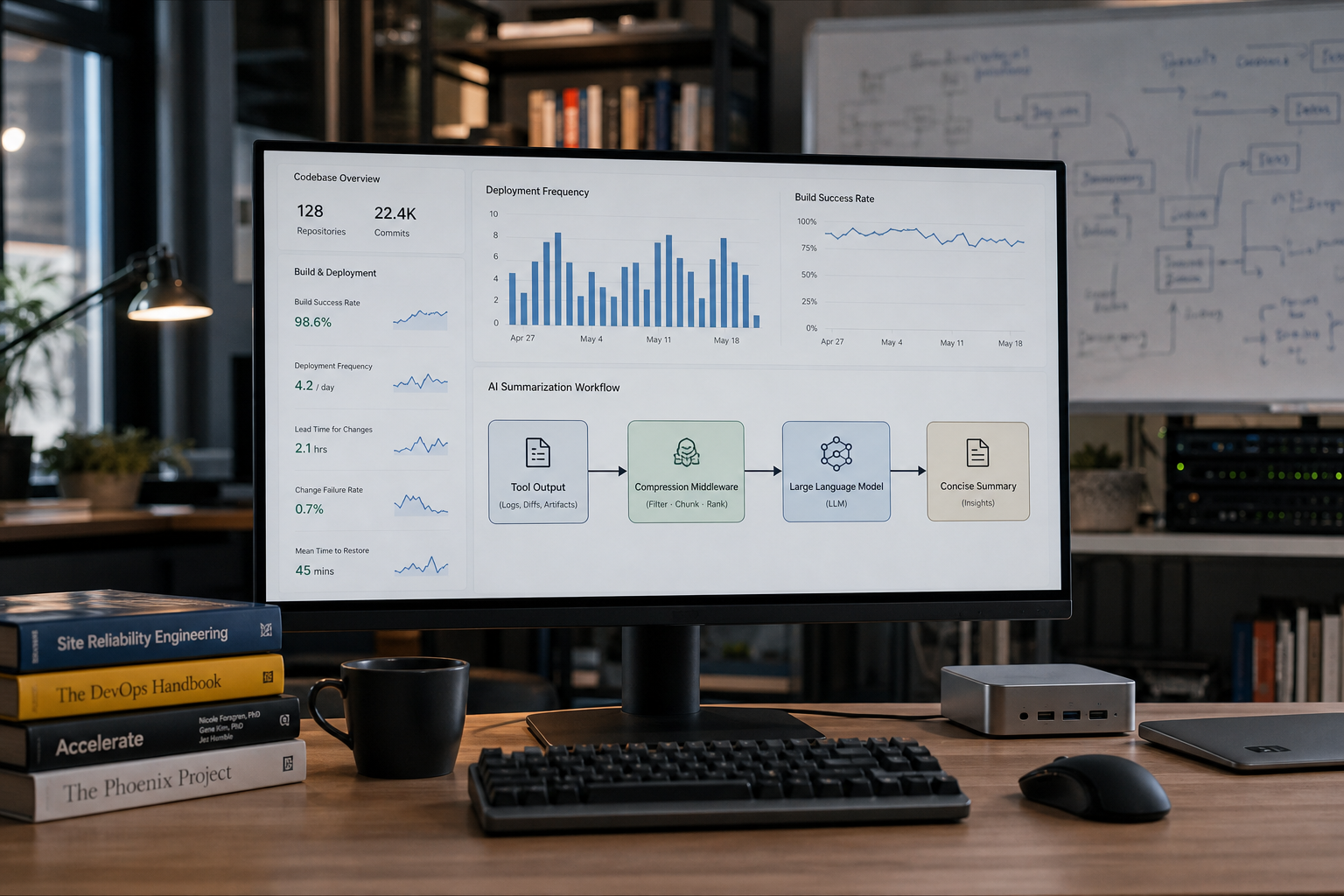
What Is Prompt Compression Middleware for DevOps
DevOps teams running AI-assisted coding workflows burn tokens on data, not reasoning. File reads, build logs, and search results fill context windows with bulk that the model re-bills on every turn. Prompt compression middleware sits between your tools and the LLM, intercepting that bulk and handing the model a distilled version instead. Lineman intercepts data-heavy tool calls and delivers compact summaries that cut token costs 40%+ on benchmarks while maintaining output quality.
How to Compare Claude Code Spend Before Log Compression in 5 Steps (2026)
Quick Guide: How to Compare Claude Code Spend in 5 Easy Steps Establish your baseline token spend — Run the /usage command at session start to capture your starting token count before any optimization. Define a repeatable engineering task — Select a consistent task like a multi-file refactor or code review that you can run identically twice. Record your pre-compression metrics — Complete the task without log compression and document total input tokens, output tokens, and session cost. Enable log compression with Lineman — Install Lineman to intercept and compress tool outputs before they enter the context window. Run the identical task and compare results — Execute the same task with compression active and calculate your percentage reduction in token spend. How to Measure Claude Code Token Spend Before and After Compression 1. Establish Your Baseline Token Spend Every valid comparison starts with a clean baseline. Open a fresh Claude Code session and run /usage immediately. This command displays your current session's token consumption in three categories: input tokens, output tokens, and estimated cost.

How to Set Token Budgets for AI Dev Teams in 7 Steps (2026)
Quick Guide: How to Set Token Budgets for AI Dev Teams in 7 Easy Steps Audit your current token consumption — Review existing API usage across teams to establish baseline spend and identify high-consumption patterns. Define budget tiers by project and team — Segment budgets by environment, project, or team so a runaway dev script cannot drain production credits. Set hard token limits per key or developer — Configure per-key caps that block requests when thresholds are reached, not just send alerts. Configure real-time usage alerts — Set threshold notifications at 50%, 75%, and 90% to catch overruns before they hit the ceiling. Establish escalation paths for budget breaches — Define who gets notified, what actions trigger, and how teams request budget increases. Implement automatic compression to reduce token waste — Lineman cuts token spend by 40%+ on data-heavy tool outputs while maintaining output quality. Review and adjust budgets monthly — Analyze usage trends and reallocate budgets based on actual consumption patterns. How to Set Hard Token Budgets and Real-Time Escalations for Enterprise AI Dev Teams 1. Audit Your Current Token Consumption Before setting any budget, you need to know where your tokens are going. Run a usage audit across all API keys and projects for the past 30-90 days.

How to Cut OpenAI and Anthropic API Spend in 2026
Your AI coding tools are burning tokens on data, not reasoning. Every file read, every build log, every search result that lands in the context window gets re-billed on each turn. On Lineman's benchmarks, tool output accounts for over half of a typical Claude Code bill—and most engineering teams don't know it until the invoice arrives.

7 CI/CD Review Routing Patterns for Lower LLM Spend
Quick guide: 7 CI/CD review routing patterns for engineering teams Lineman : The top choice for automatic tool-output compression that cuts token spend by 40%+ while maintaining review quality Code health-based triage: Routes tasks based on file complexity metrics before generation begins Diff size filtering: Skips trivial changes (whitespace, config bumps) to reduce unnecessary model calls Model tiering by task complexity: Assigns light, standard, or heavy models based on detected difficulty Semantic caching: Reuses prior review findings for similar code patterns Context compression pipelines: Summarizes bulky file reads and test logs before sending to the reviewer model Two-pass verification: Separates recall (catch everything) from precision (filter false positives) into distinct LLM calls How we chose these CI/CD review routing patterns Every pattern on this list addresses a specific cause of token waste in AI-assisted code review workflows. Your CI/CD pipeline likely sends full diffs, entire file contents, and verbose test logs to a frontier model on every PR—even when a cheaper model would produce the same result.

How to Set Token Alerts for AI Coding Teams in 7 Easy Steps (2026)
AI coding assistants are burning through tokens faster than most engineering teams realize. A single runaway loop or uncapped agent session can consume your entire monthly budget in minutes. Lineman gives you the tools to track, alert, and cap that spend before it becomes a problem.
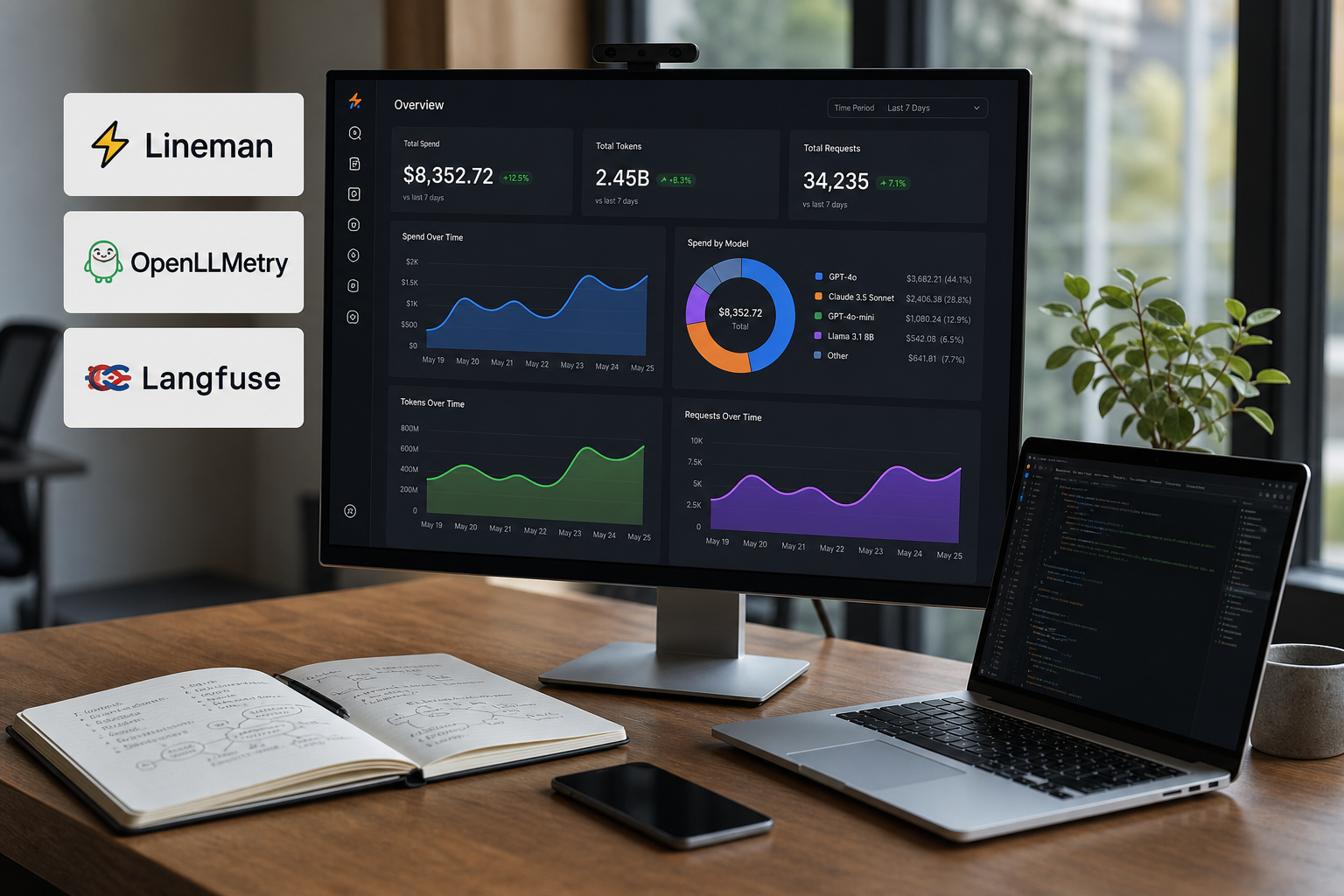
7 Open Source LLM Spend Audit Tools for 2026
Quick guide: 7 open source tools for auditing enterprise LLM spending Lineman : The top choice for automatic token compression and department-level cost visibility OpenLLMetry: Observability instrumentation for tracking LLM calls across services LiteLLM: Proxy layer with usage logging and spend tracking by API key Langfuse: Tracing and analytics for LLM applications with cost attribution Helicone: Request logging and caching with spend dashboards Pezzo: Centralized prompt management with usage monitoring LLMOps: Self-hosted platform for tracking model usage across teams How we chose open source tools for LLM spend auditing Enterprise LLM costs add up fast when you're running multiple models across departments. Each API call carries a token cost, and without visibility into where those tokens go, your monthly bill becomes a guessing game.

Cost-Effective LLM Architecture for AI Testing
Your AI testing infrastructure is burning through tokens faster than you expected. The bill keeps climbing, but you're not sure where the spend goes or how to fix it. LLM costs in software evaluation come down to two mechanics: context compounding and inefficient routing between models. Lineman helps engineering teams cut token spend by 40%+ on AI-assisted coding by compressing tool outputs and keeping context windows lean.
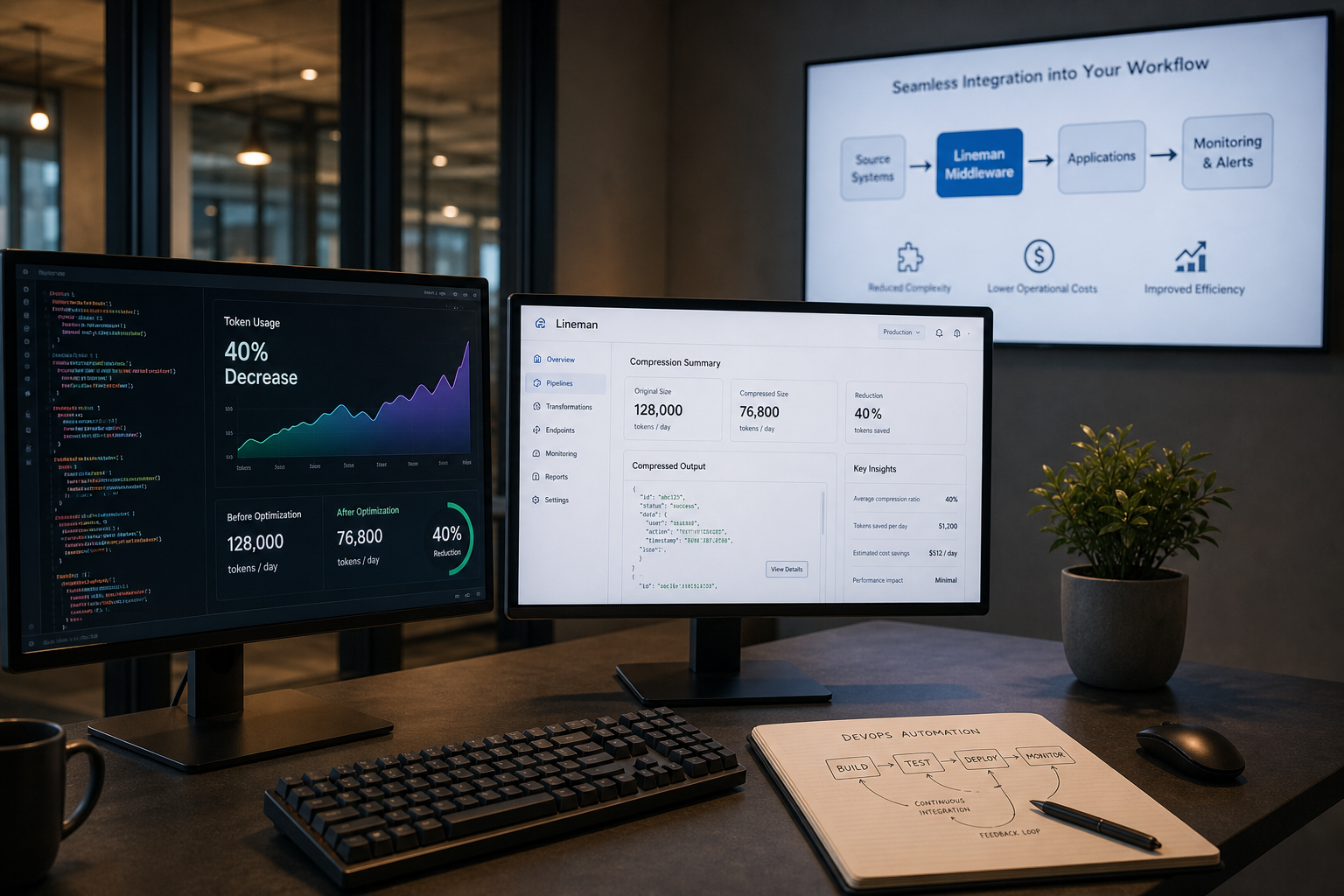
How Prompt Compression Middleware Cuts DevOps LLM Costs
Your DevOps automation costs more than it should because LLM coding tools bill for every token in the context window—including bulky tool outputs that add no reasoning value. Prompt compression middleware intercepts that data-heavy work before it reaches your main model, handing back a distilled version that preserves the information you need while cutting what you pay. Lineman uses this approach to deliver 40%+ token reduction on DevOps workflows without measurable quality loss.

How to Exclude Irrelevant Files From AI Coding Tools in 7 Steps (2026)
Your AI coding assistant reads every file it can reach. That includes the node_modules folder, ancient log dumps, and test fixtures that have nothing to do with your current task. Each of these files consumes tokens—and tokens cost money.

9 Enterprise Ways to Cut AI Coding Infrastructure Costs
Quick guide: 9 enterprise strategies for AI coding cost control Lineman : The leading solution for automatic tool-output compression that cuts token spend by 40%+ while maintaining quality Model routing: Match each task to the cheapest model that handles it Context hygiene: Clear accumulated context at task boundaries Prompt discipline: Trim system prompts to essential rules only Session management: Compact mid-task, clear between tasks Output summarization: Replace verbose tool responses with distilled versions Token monitoring: Track where your spend actually goes Tiered model delegation: Reserve frontier models for reasoning-heavy work Automated compression pipelines: Let tooling handle the grunt work How we chose these enterprise cost-control strategies Your AI coding infrastructure bill is driven by two mechanics: context compounding and verbose tool output. Every turn re-sends the entire conversation as input, so tokens accumulate fast. File reads, build logs, and search results account for over half of typical spend.

7 Tools for AI Codebase Navigation in 2026
Quick guide: 7 AI codebase navigation tools for engineering leads Lineman: The top choice for token-efficient context compression and codebase understanding Sourcegraph Cody: Code search and retrieval for distributed repositories Cursor: IDE-integrated code generation with context awareness Continue: Open-source code assistant with retrieval capabilities Aider: Terminal-based code editing with git integration Codeium: Free-tier code completion with codebase indexing Tabnine: Enterprise code completion with local processing options How we chose these AI codebase navigation tools AI coding agents burn through context windows on file reads, build logs, and search results. That's the root cause of both cost bloat and degraded reasoning on large codebases.

7 Alternatives to Bigger Context Windows for AI Agents
Quick guide: 7 alternatives to context window expansion for AI coding agents Tool-output compression: The most effective lever for cutting token spend on large codebases Model routing: Useful for delegating mechanical tasks to smaller models Codebase indexing: A retrieval-based approach for finding relevant files Semantic embeddings: A pattern-matching method for code similarity search Context pruning: Manual cleanup that works but requires discipline Summarization pipelines: A preprocessing step that condenses verbose outputs Chunked processing: A batch approach for handling files that exceed token limits How we chose the alternatives to larger context windows When your AI coding agent hits a wall on a large codebase, the instinct is to reach for a bigger context window. But that instinct has a cost—literally. Every token in the window is re-billed as input on each turn.

Claude Code Pricing, Explained: How to Cut Your Claude Code Costs in 2026
Claude Code has quietly become the most productive line item on a lot of engineering teams. It is also one of the easiest bills to lose track of. Token usage is invisible until you hit a limit or open an invoice, it scales with how busy your developers are rather than how valuable the work was, and a single runaway agent loop can chew through a week's allowance over a quiet weekend.
How to Monitor LLM Token Usage Across Teams
Your engineering teams are using AI coding assistants, and the token bill is climbing. The mechanics are straightforward: each API call to an LLM consumes tokens, and without centralized visibility, you don't know which teams, projects, or workflows are driving the spend. Lineman tracks this data automatically, but whether you're building a custom dashboard or using existing tools, you need the same core mechanics in place: metering, attribution, and cost controls.
7 LLM Architecture Patterns for Cost-Efficient Eval
Running LLM-powered software evaluation burns through tokens faster than most engineering teams expect. The mechanics are predictable: context compounding multiplies costs on every turn, and bulky tool outputs—test logs, build results, file reads—consume the majority of your bill before the model does any actual reasoning.
8 Ways to Cut AI Coding Costs in 2026
Your AI coding assistant bill is climbing. The mechanics behind it are straightforward: context compounding and verbose tool output. Lineman helps engineering teams cut token spend by 40%+ while maintaining output quality—but that's just one of the levers you can pull.
How to Compress Source Code Context for LLM Costs
Source code context compression cuts LLM API costs by reducing the tokens your coding agents send on every turn. The mechanics: intercept bulky tool outputs (file reads, build logs, search results) before they enter the context window, extract what matters, and hand the model a distilled version. On Lineman's benchmarks, this approach delivers 40%+ token reduction while maintaining output quality.
7 Safeguards for Runaway Coding Agent API Costs
Automated coding agents can finish complex tasks faster than you'd expect—and drain your API budget faster than you'd notice. When an agent enters an infinite loop or churns through thousands of tokens reading the same log file, the cost compounds on every turn.
7 Ways to Reduce Tokens in Long LLM Agent Chats
Long multi-turn agent sessions burn through tokens faster than most engineers expect. Each turn re-sends the entire conversation history, and bulky tool outputs—file reads, build logs, search results—compound the cost on every subsequent message. Lineman gives you a way to intercept that data-heavy work and keep your context window focused on reasoning instead of re-reading the same files over and over.
Automatic LLM Token Reduction in Coding Workflows
High token consumption in AI coding workflows is driven by two mechanics: context compounding (every token is re-billed on each turn) and bulky tool output (file reads, logs, search results). Lineman cuts 40%+ of tokens on our benchmarks while holding output quality by intercepting data-heavy tool calls and handing the model a compact summary. You bring the cost down with automatic compression rather than manual discipline every session.
Benchmark Claude Code Cost Savings in 2026
Your Claude Code bill climbed faster than expected. You cut prompts, tried cheaper models, and still watched costs rise. The problem isn't your effort—it's that most optimization advice skips the part that matters: proving the fix actually worked.
Best LLM Cost Tools for Engineering Teams in 2026
Engineering teams running AI-assisted coding workflows face a growing challenge: API costs that scale with every token your model processes. Lineman offers a different approach to LLM cost optimization, compressing code context and tool outputs so your frontier model spends tokens on reasoning instead of ingesting data.
Introducing Lineman
Lineman is now available for Claude Code. It compresses file reads, log triage, search, and web fetches before they reach your primary model, cutting token spend by 40%+ while keeping the quality you'd expect.
Install Lineman in two minutes
Four commands inside Claude Code and you're done. No config, no workflow changes. Your next big read just costs less.
Works with your stack
One install, every language. Lineman compresses data-heavy work whether you're in TypeScript, Python, Go, Rust, or anything else Claude Code touches.
Your code is yours
Lineman processes tool output to compress it, then moves on. We don't train on your code. A plain-English account of how your data is handled.
The parts you need, not the whole dump
Opening a 1,200-line file to use three functions shouldn't burn your context budget. Lineman hands your model the relevant parts, not a truncated dump.
How we measured 40%+ token savings
Where the 40%+ figure comes from: 180 real-world tasks across six suites, a paired quality check, and the controls that make the comparison fair.
Less noise, more signal
A coding agent is only as good as what's in its context window. How Lineman makes sure your model sees the signal and skips the noise.
SWE-Bench Pro, in the open
Averages are easy to cherry-pick. So we publish per-task runs of Lineman against a baseline on real GitHub issues, and let you check the work.
Security at Lineman
Security isn't a page you visit once. Our posture, from how we guard your account to how your code is handled in transit.
Fast by default, resilient under load
A sidekick that slows you down isn't a sidekick. Speed and graceful fallback aren't bolted on. They're constraints we designed Lineman around.
See your savings before you commit
Don't take our word for it. The calculator turns your workload into a projected token and cost reduction before you sign up.
How we prove every change saves you tokens
It's easy to claim a tool saves tokens. Proving a specific change did, without quietly costing quality, is the hard part. The measurement discipline behind our numbers.
Why a sidekick beats a bigger context window
Bigger context windows feel like the answer to data overload. They're really a more expensive way to carry the same noise. Here's the alternative.
The case for task-specific model routing
The model that's great at solving your problem is an expensive way to read a log file. Our whitepaper makes the case for routing data-heavy work elsewhere.
Trust, data protection, and compliance
Who we are, the rules we operate under, and the commitments we make about your data: UK GDPR and the company behind Lineman.