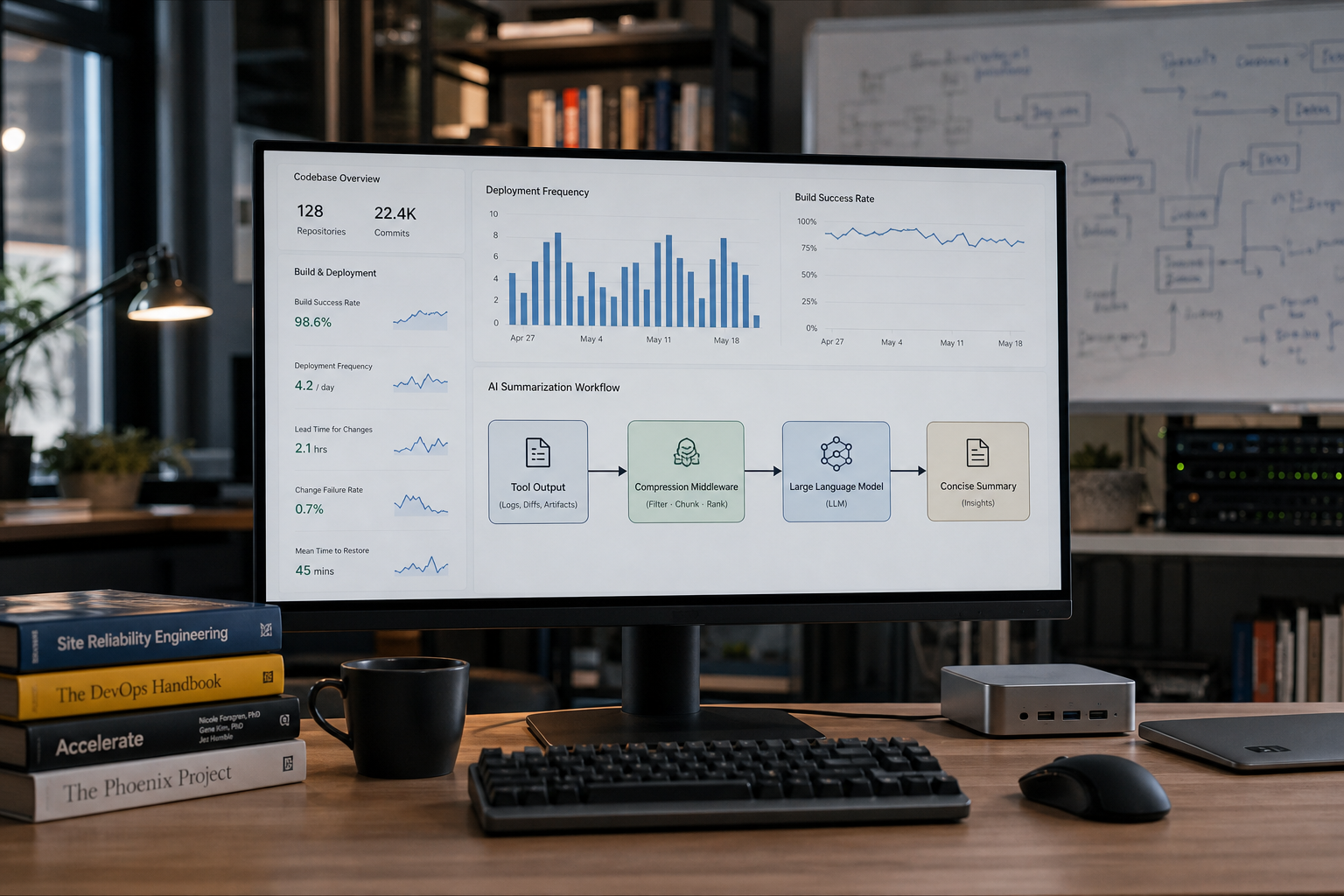
DevOps teams running AI-assisted coding workflows burn tokens on data, not reasoning. File reads, build logs, and search results fill context windows with bulk that the model re-bills on every turn. Prompt compression middleware sits between your tools and the LLM, intercepting that bulk and handing the model a distilled version instead. Lineman intercepts data-heavy tool calls and delivers compact summaries that cut token costs 40%+ on benchmarks while maintaining output quality.
This article explains what prompt compression middleware does, how it works at the system level, and why open source options fit DevOps workflows without adding friction to your process.
Key Takeaways: What Is Prompt Compression Middleware for DevOps
- Prompt compression middleware intercepts tool output before it enters the LLM context window, reducing token usage.
- Context compounding causes each turn to re-bill the entire accumulated context, multiplying costs as sessions grow.
- Open source middleware options integrate into existing DevOps pipelines without requiring workflow changes.
- Lineman achieves average 53% token reduction with 98.3% baseline output quality retention on data-heavy tasks.
- Middleware routes mechanical data processing to smaller models while preserving frontier model reasoning capacity.
What Is Prompt Compression Middleware?
Prompt compression middleware is software that sits between your DevOps tools and the LLM API. When a coding agent calls a tool that returns file contents, build logs, or search results, the middleware intercepts that output before it reaches the model's context window.
Instead of passing the full output to the LLM, the middleware compresses it into a shorter form that preserves the information the model needs for reasoning. The original prompt flow looks like this: tool output → LLM inference. With middleware, it becomes: tool output → compressor → distilled version → LLM.
This matters because models are stateless. Every turn re-sends the whole conversation as input. A 10,000-token file read from turn three gets billed again on turn four, five, and every subsequent turn until you clear context.
Why Does Tool Output Drive LLM Costs in DevOps?
LLM coding costs come from two mechanics: context compounding and bulky tool output. Context compounding means every token in the window gets re-billed as input on each turn. Your accumulated context acts as a multiplier on every token you spend.
Tool output is the larger factor. File reads, build logs, test results, and search results load into context as bulk data. According to Anthropic's context engineering research, this bulk competes with the model's attention budget for reasoning tasks.
On Lineman's data, tool output accounts for over half of a typical bill. That's why compression middleware targets tool calls specifically—it addresses the largest cost driver directly.
How Does Prompt Compression Middleware Work?
The middleware intercepts tool calls at the API layer. When your coding agent requests a file read or runs a build command, the middleware receives the full output first. It then applies compression techniques to reduce token count while preserving essential information.
Common compression approaches include extractive methods that select the most relevant portions of the output, and summarization methods that rewrite content in shorter form. Advanced middleware uses model-based compression that understands code structure and can identify which portions matter for the current task.
The result: the model receives a compact, task-relevant summary instead of bulk data. Because the bulk never enters context, it's never billed—not once and not on any later turn.
What Makes Open Source Middleware Fit DevOps Workflows?
Open source prompt compression middleware integrates into existing tool chains without requiring you to change how you work. You keep prompting exactly as you do now while the middleware handles compression automatically.
Key characteristics of DevOps-ready middleware include language-agnostic compression that works across your codebase regardless of programming language. Installation should take minutes, not days. Lineman installs inside Claude Code with no workflow changes and starts compressing tool output immediately.
Open source options also give you visibility into what's being compressed and how. You can inspect the distilled version to verify the middleware preserves what you need for your specific use case.
Which DevOps Tasks Benefit Most from Prompt Compression?
Data-heavy internal tasks see the largest savings. File reads return entire source files when you often need only specific functions or sections. Build logs dump thousands of lines when you need the error summary. Test runs produce verbose output when you need pass/fail status and failure details.
Lineman delivers up to 75% savings on these data-heavy internal tasks by compressing file reads, build logs, and search results before they enter context. This directly counters context compounding by keeping the window lean.
Long coding sessions also benefit. As context accumulates over dozens of turns, compression prevents the window from filling with stale data. This enables longer coherent sessions without degraded model performance.
How Does Middleware Preserve Output Quality?
Compression that damages output quality defeats the purpose of reducing costs. Effective middleware maintains a high quality threshold across compression operations.
On Lineman's benchmarks, compression achieves 27-58% token cost reduction on large files with no measurable quality degradation. The average across tasks shows 53% token reduction with 98.3% baseline output quality retention.
Quality preservation depends on the compression method. AST-aware analysis (Abstract Syntax Trees) understands code structure and preserves semantically important elements. Token-level optimization removes filler while keeping the core information intact.
What's the Difference Between Middleware and Manual Context Management?
You can manage context manually by clearing history between tasks, compacting mid-session, and trimming prompts. These levers work, but they require discipline every session. You have to remember to run /clear when you switch tasks and /compact on long sessions.
Middleware handles the largest cost—tool output—automatically. You keep prompting exactly as you do now while the middleware intercepts and compresses data-heavy tool calls in the background.
The trade-off: manual tactics give you direct control but require consistent effort. Automatic compression runs without intervention but requires trust in the middleware's compression quality.
How Do You Evaluate Prompt Compression Middleware?
Evaluate middleware on three dimensions: compression ratio, quality retention, and latency impact. Compression ratio tells you how much smaller the output becomes. Quality retention measures whether the compressed output still supports the same model reasoning. Latency measures how much time the compression step adds.
Lineman achieves sub-2-second latency per delegated task on CPU-only inference. For most workflows, this processing time is fast enough to be unnoticed. Run your own benchmarks on representative tasks from your codebase to verify performance in your environment.
Also evaluate integration requirements. Middleware that requires major workflow changes creates adoption friction. Look for options that install quickly and work with your existing tools.
In Conclusion: How to Choose Prompt Compression Middleware for Your DevOps Workflow
Prompt compression middleware addresses the root cause of high LLM costs in DevOps workflows: bulky tool output that compounds across turns. Open source options fit into existing pipelines without workflow changes.
Start by measuring where your tokens go. Run /context or equivalent commands to see the breakdown. If tool output dominates, middleware will have the largest impact. If your costs come from other sources, you may need different levers.
Lineman cuts token spend by 40%+ while maintaining expected quality, installs in minutes, and runs automatically once configured. The free trial lets you estimate projected savings before committing.
FAQs about What Is Prompt Compression Middleware for DevOps
What is prompt compression middleware?
Prompt compression middleware intercepts tool output like file reads and build logs before they reach the LLM. It compresses bulky data into distilled versions, reducing token costs while preserving the information the model needs for reasoning tasks.
How does prompt compression reduce LLM API costs?
Models re-bill the entire context on every turn. Compression shrinks tool output before it enters the window, so the bulk is never billed—not once and not on subsequent turns. Lineman cuts 40%+ of tokens on benchmarks while holding output quality.
Does prompt compression affect output quality?
Effective middleware preserves quality while reducing tokens. Lineman achieves 98.3% baseline output quality retention with 53% average token reduction. Quality depends on the compression method—AST-aware analysis preserves code structure better than naive truncation.
Can I use open source prompt compression middleware with existing tools?
Open source options integrate into existing DevOps pipelines without workflow changes. Lineman installs inside Claude Code in minutes and starts compressing tool output immediately. You keep prompting exactly as you do now.
Which DevOps workflows benefit most from prompt compression?
Data-heavy tasks see the largest savings: file reads, build logs, test runs, and search results. Lineman delivers up to 75% savings on these internal tasks. Long coding sessions also benefit because compression prevents context window bloat over many turns.