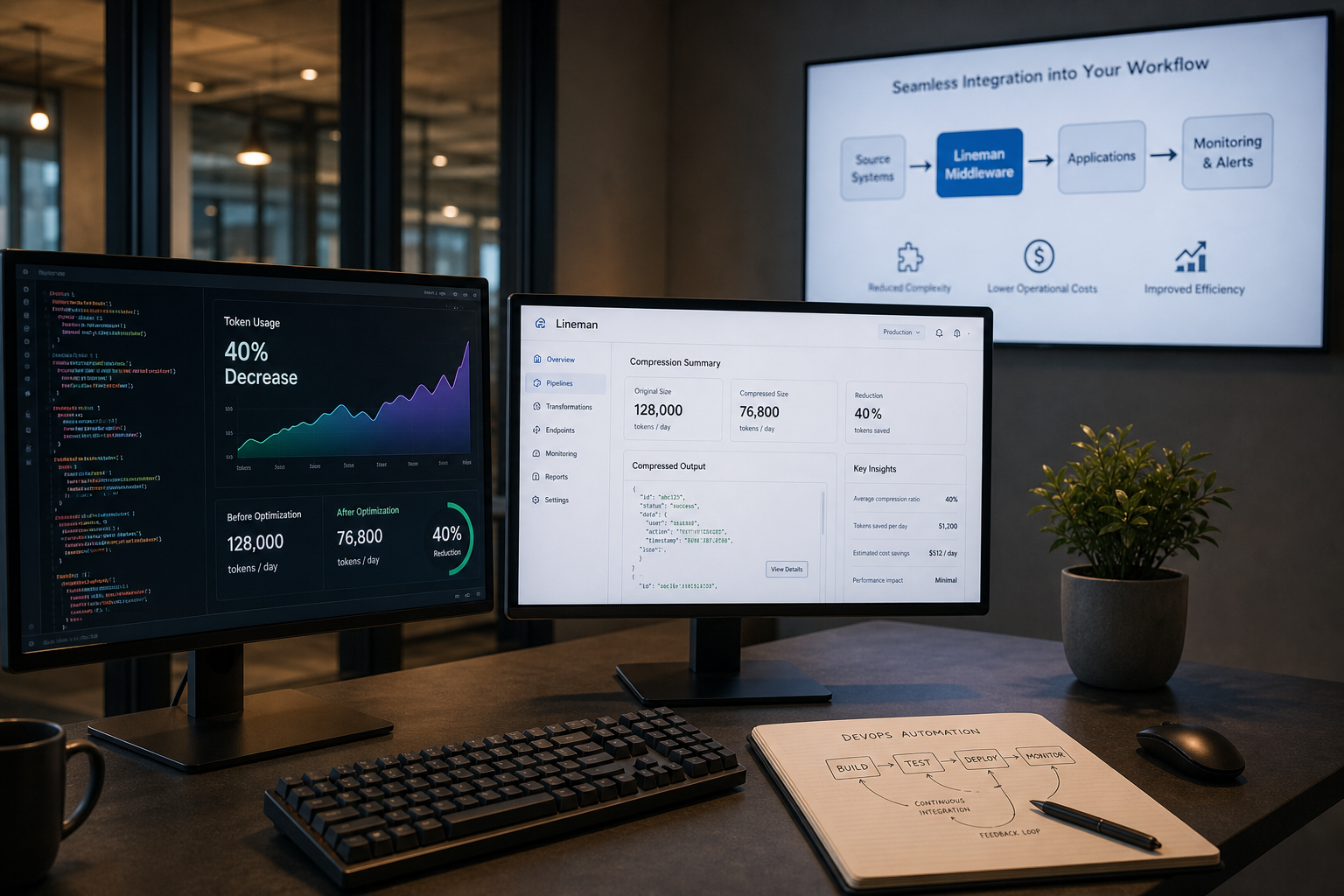
Your DevOps automation costs more than it should because LLM coding tools bill for every token in the context window—including bulky tool outputs that add no reasoning value. Prompt compression middleware intercepts that data-heavy work before it reaches your main model, handing back a distilled version that preserves the information you need while cutting what you pay. Lineman uses this approach to deliver 40%+ token reduction on DevOps workflows without measurable quality loss.
This article walks you through the mechanics of prompt compression middleware, how it differs from static tokenizers, and why dynamic compression matters for DevOps automation.
Key Takeaways: How Prompt Compression Middleware Cuts DevOps LLM Costs
- Prompt compression middleware intercepts tool outputs and delivers distilled summaries before tokens enter your context window.
- Dynamic compression outperforms static tokenizers by adapting to task context and preserving reasoning-critical information.
- Lineman's middleware integration achieves 40%+ token savings on DevOps tasks while maintaining 98.3% baseline output quality.
- Context compounding multiplies your costs because every turn re-sends the entire conversation as input to stateless models.
- Middleware-based compression works automatically without requiring manual prompt discipline or workflow changes.
What Is Prompt Compression Middleware?
Prompt compression middleware sits between your DevOps tools and your LLM, intercepting data-heavy outputs like file reads, build logs, and search results. Instead of passing the full output to your main model, the middleware compresses it into a task-relevant summary that preserves meaning while reducing token count.
This approach addresses the root cause of high LLM costs in DevOps: tool output is bulky. IBM's prompt compression tutorial explains how compression removes low-value prompt content to cut costs without sacrificing task performance. The middleware intercepts the data before it enters context, so you never pay for tokens that add no reasoning value.
How Does Dynamic Compression Differ from Static Tokenizers?
Static tokenizers apply fixed rules to every prompt, regardless of what the model needs for the current task. Dynamic compression middleware analyzes the task context and preserves the information most relevant to the model's reasoning.
The difference shows up in output quality. Static approaches risk stripping information the model needs, leading to degraded responses. Dynamic middleware—like what Lineman uses—maintains output quality by keeping reasoning-critical content intact while removing noise like verbose log formatting and redundant file headers.
Why Context Awareness Matters for Token Optimization
A build log from a failed test run contains different information than a successful one. Static tokenizers treat both the same way. Dynamic middleware recognizes the failure markers and preserves the stack trace while compressing routine status lines.
This context awareness is why Lineman achieves 98.3% baseline output quality retention. The compression adapts to what the model genuinely needs for each task.
Why Does Context Compounding Drive DevOps Costs?
LLMs are stateless. Every turn re-sends the entire accumulated context as input. If your first message costs 1,000 tokens and your second adds 500, you pay for 1,500 tokens on turn two—not just the 500 new ones. By turn ten, you're paying for the full sum every single time.
Tool outputs make this worse. A single file read or test log can add thousands of tokens that get re-billed on every subsequent turn. Middleware compression keeps your context window lean, directly countering this compounding effect.
How Does Middleware Integration Work in DevOps Workflows?
Middleware integration happens at the tool output layer, not the prompt layer. When your coding agent requests a file read or runs a test, the middleware intercepts the response before it reaches your main model.
Lineman installs in minutes inside Claude Code with no workflow changes required. You keep prompting exactly as you do now—the compression happens automatically in the background. This eliminates the manual prompt discipline that most cost-reduction guides require.
What Outputs Does Middleware Compress?
The bulkiest outputs in DevOps automation are file reads, build and test logs, search results, and kubectl output. These account for over half a typical bill on Lineman's data. The middleware compresses each type differently based on what information the model needs.
For test logs, that means preserving failure messages and stack traces. For file reads, it means keeping code structure while trimming repetitive comments and whitespace.
What Token Reduction Can You Expect?
Lineman's benchmarks show 40%+ token reduction on DevOps workflows, with up to 75% savings on data-heavy tasks like large file processing and log triage. The savings compound across your session because smaller context means lower re-billing on every turn.
To fix the cause of high LLM costs, you need to understand two mechanics: context compounding and verbose tool output. Middleware addresses both automatically—without requiring you to remember manual tactics every session.
In Conclusion: Why Middleware Beats Manual Prompt Compression
Manual prompt compression requires discipline every session. You have to remember to clear context at task boundaries, compact mid-task, and trim your system prompts. Middleware handles the largest cost driver—tool output—automatically.
Lineman's middleware approach means you keep your existing DevOps workflow while the compression happens in the background. The result is lower token costs without sacrificing the output quality your engineering team expects.
FAQs About How Prompt Compression Middleware Cuts DevOps LLM Costs
What is prompt compression middleware?
Prompt compression middleware intercepts tool outputs—file reads, logs, search results—before they enter your LLM context window. It delivers a distilled version that preserves task-relevant information while cutting token count. Lineman's middleware achieves this automatically without requiring workflow changes.
How much can prompt compression reduce my LLM costs?
On Lineman's benchmarks, prompt compression middleware delivers 40%+ token reduction on typical DevOps workflows. Data-heavy tasks like large file processing see up to 75% savings. These reductions compound across your session as smaller context means lower per-turn costs.
Does compression affect output quality?
Dynamic compression preserves reasoning-critical information while removing noise. Lineman maintains 98.3% baseline output quality retention because the middleware adapts to what the model needs for each task, rather than applying fixed rules.
How does middleware integration work with my existing tools?
Lineman installs in minutes inside Claude Code with no configuration changes. The middleware intercepts tool outputs automatically, so you keep prompting exactly as you do now. Your workflow stays the same—only your token costs change.
Why is dynamic compression better than static tokenization?
Static tokenizers apply the same rules regardless of task context. Dynamic middleware analyzes what the model needs for each specific operation. This means Lineman preserves failure details in test logs while compressing routine status output—something static approaches cannot distinguish.